
You support authors you like. You buy their books, therefore you support them, right? Yes, but… Where and how you buy a book can matter as much to the author’s bottom line as whether you bought it at all. Sadly, the publishing industry operates on a set of archaic rules so lopsided that even if a book becomes a bestseller, its author may still lose money.

The hidden, ugly thing about bookselling
When a bookstore orders copies of a book, it isn’t the straightforward sale it appears to be. The book retail industry has historically operated more like a consignment arrangement. A retailer, whether it’s a Barnes & Noble, an independent shop, or a big-box store like Target, orders books from a distributor, stocks them on shelves, and then, if the books don’t sell within a relatively brief period of time, two or three months, sends them right back for a full refund.
This practice of “returnable” inventory was baked into the bookselling industry during the Great Depression as a way to encourage retail booksellers to take risks on unknown authors. The logic was reasonable: if a bookstore could return what it didn’t sell, it would be more willing to stock titles with uncertain commercial appeal. In theory, this should have opened doors for authors, but in practice, it created chaos.
Publishers, anticipating demand that may never arrive, routinely overprint. Bookstores, fearing they’ll miss a hit, overbuy. And when the books don’t move, they get shipped back. For titles by debut or small-press authors, the number of returns can be staggering. In trade publishing’s big-box retail model (think Costco, Walmart, and Target) return rates of 30 to 40 percent are not unusual. Those numbers are crippling for a small press and its authors.
When a “sale” isn’t really a sale
Here’s where it gets particularly painful for authors.
When a retailer orders a book, the money flows, briefly, in the right direction. The retailer buys at a wholesale discount (typically 55% off the cover price) from a distributor. The distributor passes royalties to the publisher, who pays the author their contracted percentage. So far, so good.
But that initial transaction is what the industry calls a “soft sale.” If the book comes back, those royalties come back too as a negative line item on the author’s royalty statement. The author has already been paid; now they owe it back. Distributors also charge a per-unit restocking fee on returned copies, meaning publishers, and by extension, authors lose money coming and going.
This system evolved for reasons that once made sense. But it has calcified into something that harms the very people doing the creative work, and there’s been no regulation to address it.
The big-box and algorithm problem
The returns crisis is inseparable from the broader shift in who sells books and how they sell them.
When trade publishing orients itself toward high-volume retailers with massive floor space and razor-thin margins, the inevitable result is aggressive ordering followed by aggressive returns. A celebrity biography ordered in bulk by a big-box chain can come flooding back the moment public sentiment turns, and books tied to news cycles or seasonal trends vanish from shelves before they find their readers.
Meanwhile, Amazon makes 60% of all book sales today, and that gives it unreasonable leverage over publishers’ terms, discounts, and visibility. For readers, the algorithm feels helpful, with recommendations, one-click purchasing, and overnight delivery. For authors and small publishers, however, the reality is more complicated. Royalty structures vary dramatically depending on the platform, the price point, and whether the author goes through a publisher or self-publishes.
The point is that authors—especially debut, independent, and small-press authors—are the least protected participants in a system that treats books like produce: stock the shelves, and if it doesn’t move, send it back.
What you, the reader, can actually do:
Here’s the good news: readers have more power than they know. Every deliberate purchasing decision is a small vote for the kind of publishing world we all want to exist. Here are a few suggestions to help you to help the author (and the small press) the next time you buy a book:
- Buy directly from the author or publisher when possible. A direct sale from an author’s or publisher’s website typically puts 20 to 30 percent more money in that author’s pocket than a sale through a major retailer. Purchasing direct cuts out multiple middlemen and ensures that more money goes to the creators of the book.
- Request books at your local independent bookstore. Even if the store doesn’t stock a title, walking in and asking for it creates a demand. Readers asking for a book are more persuasive to a bookseller than an author asking for shelf space, and getting a book onto physical shelves opens the door to discovery that no algorithm can fully replicate.
- Leave reviews. On Amazon, on Goodreads, on your own social feeds. Reviews improve an author’s algorithmic visibility and they also help the next reader make the decision about buying that book. For independent and small-press authors, a handful of genuine reviews can really shift how a title performs.
- Recommend books vocally. Word of mouth is still the most powerful sales engine in any field. A personal recommendation, whether by text message, a post on social media, or a mention at book club can drive sales in ways no marketing budget can replicate.
- Borrow from the library, and then tell the library what you loved about the book. Library checkouts of physical books or digital books also generate royalties, and library purchase requests help small-press titles reach institutional collections. Librarians listen. (And come on! You’re supporting libraries at the same time… We need libraries!)
- Support literary culture broadly. Subscribe to literary magazines. Attend author readings. Follow small presses on social media. The infrastructure that produces good books depends on an ecosystem of support that goes beyond individual transactions.
The bottom line
Publishing is a business built on optimism. Every book represents a bet by the author, the press, and the bookseller that someone will care about that book. Readers are crucial to those bets paying off.
So, buy the book directly from the author or publisher if you can. Bookshop.org is a good alternative if you would rather shop on line. Then tell someone about the book. Ask your local bookstore and library to carry it. Leave a review. The authors you love are counting on more than your enthusiasm; they’re counting on you to help keep the lights on.
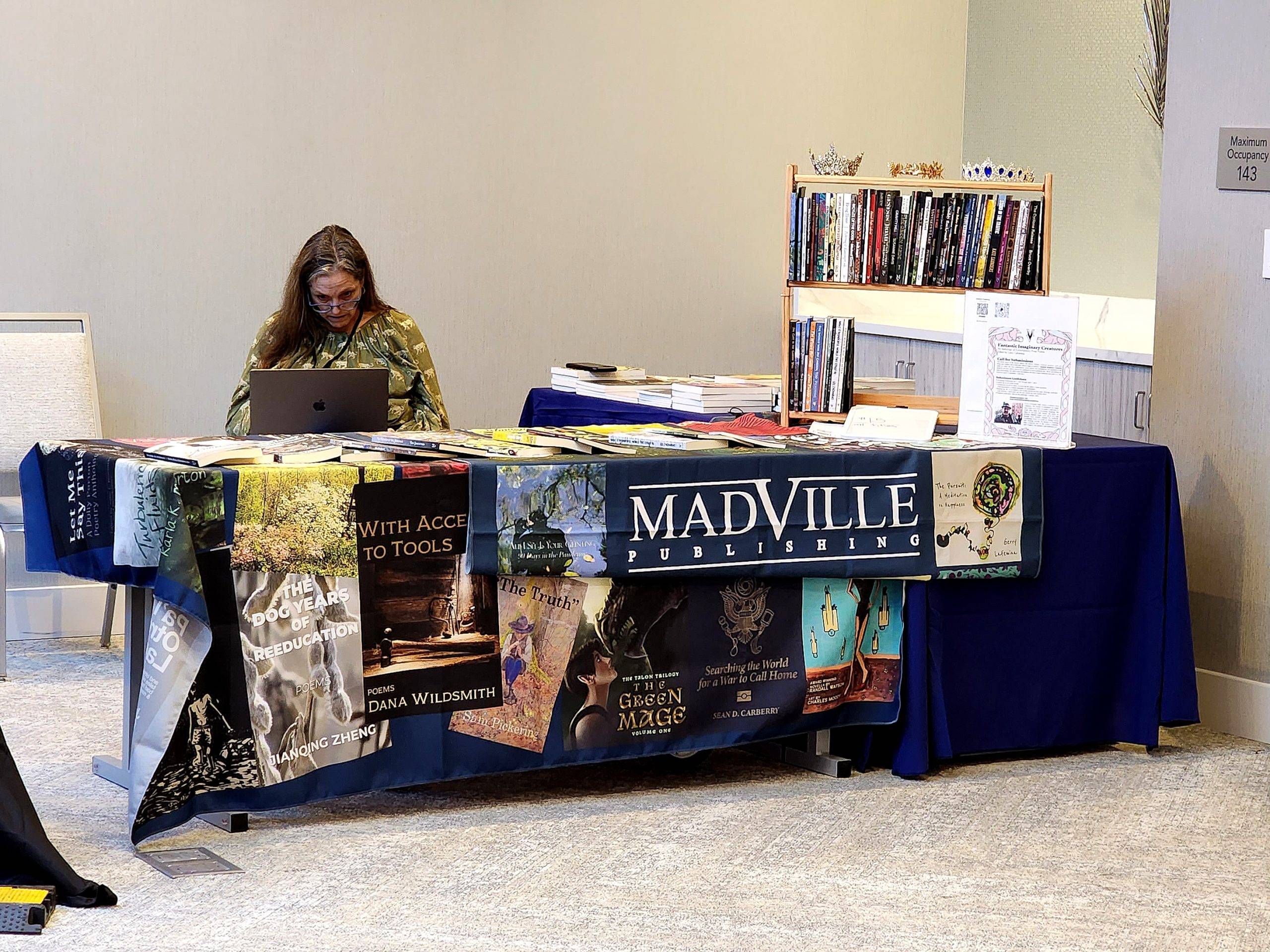
Madville Publishing is an independent literary press committed to supporting authors and building a more equitable publishing ecosystem. Browse our catalog and purchase directly at madvillepublishing.com.
![Keynote author J. Lawrence Matthews (One Must Tell the Bees: Abraham Lincoln and the Final Education of Sherlock Holmes), author Ruthie Landis (Acting Lessons for Living: Guided Journal), author Kathy Ramsperger (The Shores Of Our Souls), author T.K. Thorne (Behind the Magic Curtain), [Unknown]. [Unknown], [Unknown], author Lara Bernhardt (Red Rain), and author Beth M. Howard (Making Piece) pose for a group photo during the Author Meet and Greet and Book Launch for Anju Gattani's "Dynasties" event.](https://madvillepublishing.com/wp-content/uploads/2023/01/C0F18831-66E5-489D-9BEA-80E67BF973A6_1_105_c.jpeg)